
Prop it up.
A few years ago I watched a friend of mine speak on stage.
He’s a speaker who talks about creating really good businesses in the healthcare world.
There were a couple of hundred people in the room and he got to a point in his keynote where he was telling a very personal story. He brought a chair onto the stage, put it down, sat on it and then told us his story.
There was definitely a change in energy in the room.
Everyone quietened down and people paid attention and focused on him even more.
It was quite magical to be part of that.
Afterwards I was chatting with him and I said “why did you use the chair?”.
His answer was simple - “I saw you sit on the stage a few years ago and thought I’d give it a go”.
A lot of the stuff we learn about when it comes to speaking is emulated or borrowed.
We often try things that we’ve seen other people do to see if they fit.
This was one of those occasions.
His reference point was a keynote I did a few years ago when I sat on the edge of the stage, it accidentally became something very useful.
I hadn’t planned it.
No one had advised me to do it.
And to be honest I was probably just really comfortable and didn’t want to move.
But I remember starting to speak to the audience and it just felt like a conversation.
Yes it was a conversation between me and a room of 200 people but it very much changed the energy in the room.
In the conversations that you have on a day-to-day basis, you probably do this naturally and intuitively anyway.
If somebody wants to have a conversation with you about something which is important, delicate, or personal, you might pull up chairs and sit down and have that conversation.
In one of my keynotes I regularly use a chair as part of my delivery. One accidental move a few years ago has now become something which is an integral part of my work.
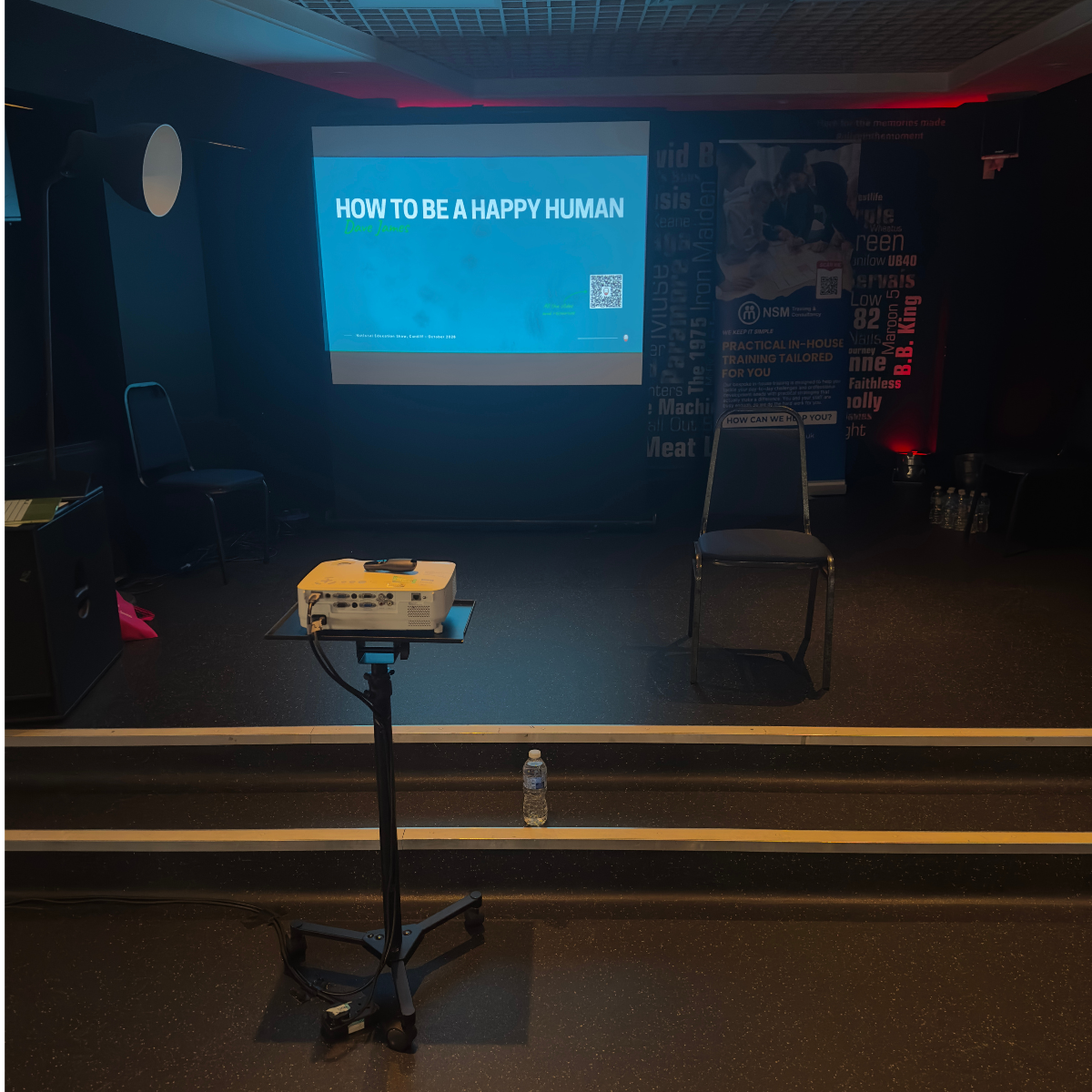
That chair is a prop.
It’s a support. It’s there to prop up my message.
Actors use them all the time because they add something to the scene. It might tell you a little bit more about the character, or their intention or what might happen next.
As a speaker you can use them in your work to support what you’re doing.
Like slides.
Or the framework you use to write your speech.
And the stories you tell.
But they have to have context.
I’ve talked before about Chekhov’s gun. The concept in literature that if you introduce something in a story, like a gun, then something has to happen with it.
Props are the same. Don’t bring them into your work if you’re not going to use them.
Because like many things in speaking, a prop has the ability to connect or disconnect with the audience.
If you use them poorly - too much, the wrong ones, or ones that aren’t subtle enough - you lose your audience.
Plus audiences get suspicious when they can see the lesson coming through a prop before it even gets there.
It ruins the surprise and the magic.
Like giving someone the answer while you ask the question.
The chair I use has a very particular purpose.
It signals a change in pace and energy and it allows me to connect my story to me and the audience in a much deeper way.
It brings people into my world and it changes “speaking at” to “speaking with.”
No one really teaches you how to use props.
Often it becomes a case of trial and error.
Perhaps realising that the thing that you have on stage is actually a prop and you’d never called it that.
Or someone in the audience pointing out to you afterwards.
Like all things in speaking, it’s about trying something, reviewing it and then deciding if you want to use it again.
Test and measure and all that.
But don’t feel that you have to use props. In fact sometimes the best thing you can do is not use them at all.
I am so grateful for that one moment of sitting on the stage a few years ago.
Because now I use it often.
Sometimes being lazy can pay off.
P.S. Want to have a chat about you speaking? Drop me a message.